My Block, My Brand: The Rise of the Hyper-Specific American Local

Asking someone where they're from used to be a simple question. These days, it can take a while to answer. "I'm from Chicago" becomes "I'm from the North Side" becomes "I'm from Logan Square, actually, not Wicker Park, those are completely different" — said with the kind of precision that makes an outsider realize they've wandered into a conversation with stakes they didn't know existed.
This is hyper-local identity, and it's one of the more fascinating cultural developments of the past few years. Americans are getting increasingly specific about where they belong, and that specificity is reshaping tourism, retail, food culture, and the way brands think about marketing to a country that has never been as monolithic as it looked from the outside.
The Granularity Is the Point
There's a reason people are getting more specific, not less. As the internet made it possible to connect with anyone anywhere, it also made a lot of people acutely aware of how much gets flattened when you zoom out too far. "The South" as a monolith erases the difference between coastal Georgia and rural Mississippi. "The Bay Area" papers over the wildly distinct cultures of Oakland, San Francisco, and San Jose. "Brooklyn" has become a lifestyle brand that has almost nothing to do with large parts of actual Brooklyn.
When a place becomes a brand, the people who actually live there often feel like they've been replaced by a logo. The hyper-local movement is partly a reaction to that displacement — a reassertion that the real thing is more specific, more complicated, and more interesting than whatever the shorthand version has become.
Social media has accelerated this in unexpected ways. Neighborhood-specific Instagram accounts and subreddits have become genuine community infrastructure in a lot of American cities. The r/EastNashville subreddit has over 30,000 members who talk about specific intersections, specific restaurants, specific issues with specific local officials. That's not a city conversation — that's a block conversation, scaled up slightly.
The Merchandise Is Getting Granular Too
Nothing signals the arrival of an identity trend quite like someone trying to sell it back to you, and hyper-local merchandise is having a serious moment. It's moved well beyond the "I Love NY" model — which was always more of a tourist artifact than a genuine identity marker — into something more specific and more personal.
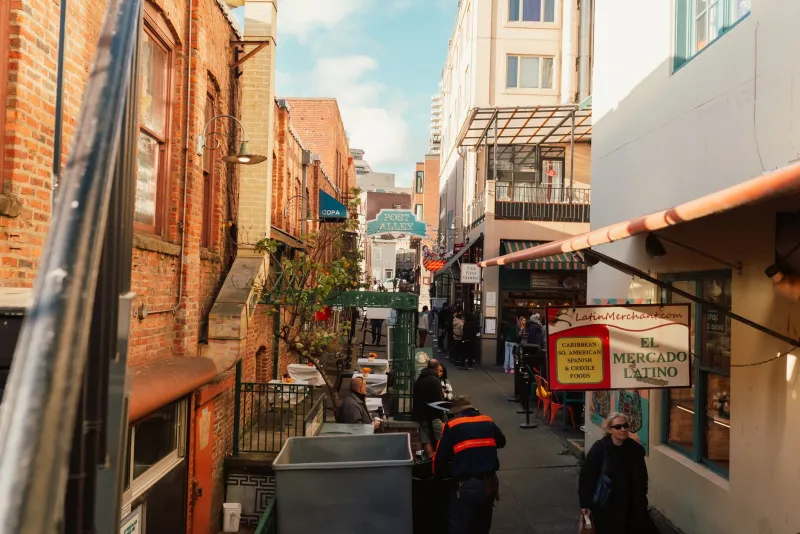
Shops in cities like New Orleans, Detroit, and Philadelphia are selling gear that references not just the city but particular neighborhoods within it — sometimes particular streets. A hoodie that says "Bywater" rather than "NOLA." A tote bag with a Hamtramck reference that only makes sense if you know Hamtramck. These items function as signals, ways of identifying yourself to the people who will recognize the reference and being invisible to those who won't.
The commercial logic here is interesting. Hyper-local merchandise has a smaller potential market by definition, but it has a much higher meaning density. The person who buys a Pilsen-specific hat isn't buying a Chicago souvenir — they're buying a piece of identity, a way of saying something specific about where they've been, who they are, what they care about. That's a different transaction, and people pay differently for it.
How Brands Are Trying to Keep Up
For national brands, the hyper-local turn presents a genuine strategic puzzle. The economies of scale that make national marketing efficient depend on being able to speak to large groups at once. But if the cultural energy is moving toward specificity, blanket messaging starts to feel tone-deaf — the brand equivalent of calling everything between Pennsylvania and California "the Midwest."
Some brands are experimenting with what you might call modular localism: national campaigns with locally customized elements, or products developed specifically for particular regional markets. A few food and beverage brands have gotten sophisticated about this — releasing flavors or formulations that are only available in specific cities, or partnering with hyper-local creators rather than national influencers.
The risk is inauthenticity. There's a long, undistinguished history of national brands trying to seem local and landing somewhere between patronizing and absurd. Getting the granularity right requires actual knowledge of a place — its specific references, its internal hierarchies, its ongoing arguments — and that knowledge is genuinely hard to acquire from a marketing department in another city.
The brands that seem to be doing it well tend to be the ones that hire locally, not just market locally.
Food as the Sharpest Edge
Nowhere is hyper-local identity more charged than in food culture. American regional food has always been a site of intense pride and territorial feeling, but the specificity has ratcheted up. It's no longer enough to claim a city's signature dish — now the argument is about which neighborhood, which era, which specific family recipe constitutes the authentic version.
This plays out in real and sometimes heated ways. The ongoing debates about Chicago pizza aren't really about pizza — they're about what Chicago is, who gets to define it, and which version of the city's identity gets exported to the rest of the country. Similar arguments happen around Memphis barbecue, Texas brisket, San Francisco sourdough, and dozens of other foods that have become proxies for something much bigger than lunch.
Chefs and restaurateurs who understand this are leaning into specificity as a value proposition. Opening a restaurant that's explicitly about a particular neighborhood's food history, or a particular immigrant community's specific regional cuisine, is increasingly a viable and respected approach — both commercially and critically.
The Identity Is the Destination
For tourism, hyper-local thinking is creating new opportunities. Travelers who've already done the top-ten-attractions version of major American cities are increasingly looking for something more specific — not just New Orleans, but the particular stretch of Magazine Street that doesn't appear in travel guides. Not just Nashville, but the actual neighborhoods that longtime residents care about.
Some cities are starting to build tourism infrastructure around this — neighborhood-specific walking tours, curated itineraries developed by long-term residents, experiences designed around the actual texture of daily life in a place rather than its greatest hits.
It's a more demanding kind of travel, and a more rewarding one. And it reflects something genuine about where American culture is right now: done with the easy answer, interested in the specific one.
Your zip code, it turns out, contains multitudes. And people are finally paying attention.