A Pinch of This, a Handful of That: How a Generation Learned to Cook Without a Recipe
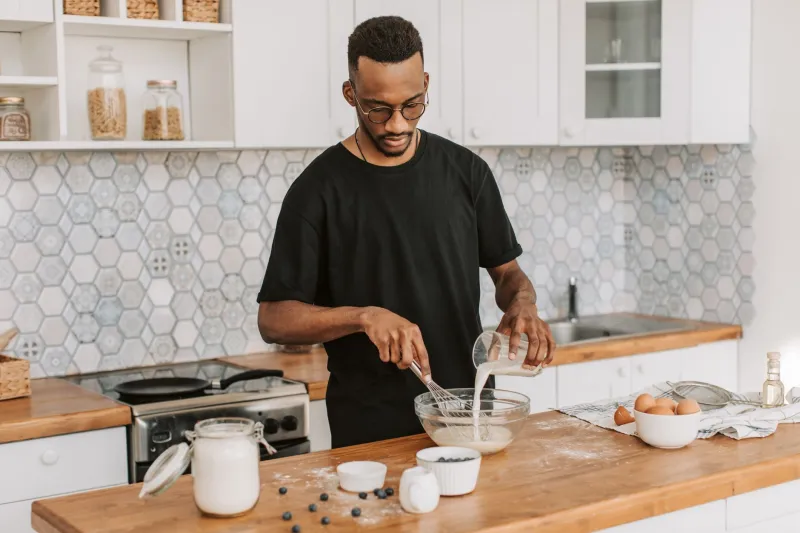
The video has 2.3 million views. In it, a twenty-two-year-old is making pasta. She doesn't measure anything. She gestures at olive oil, says 'like, enough of this,' adds what appears to be an alarming amount of red pepper flakes, and declares the result 'so good, trust.' The comments are full of people saying they tried it and it worked.
This is where American home cooking lives now.
For most of culinary history, recipes were the point. Cookbooks were passed down through families. Julia Child told you exactly how much butter. The precision was the promise — follow the steps, get the result. But something shifted, and it didn't happen gradually. It happened in the time it took TikTok to go from a lip-sync app to the world's most influential food media platform.
The Vibe-Based Kitchen
Call it intuitive cooking, improvisational cooking, or just cooking the way your grandmother did before anyone wrote anything down — younger Americans are increasingly resistant to the idea that food requires a formula.
The appeal is partly practical. Recipes assume you have specific ingredients. Real life means you have half a can of coconut milk, some wilting spinach, a protein of ambiguous vintage, and thirty minutes. TikTok's loose, gesture-based instruction style meets people where they actually are — standing in front of an open fridge at 7 p.m., trying to make something that tastes intentional.
But there's an ideological layer too. Precision has started to feel like gatekeeping. The elaborate, technique-heavy cooking content that dominated food media in the 2010s — the perfectly plated restaurant-style dishes, the molecular gastronomy rabbit holes — required equipment, time, and a certain kind of confidence that a lot of home cooks didn't have. Measurement-free cooking democratizes the kitchen. It says: you don't need to know what a brunoise is. You just need to be willing to try.
TikTok as Culinary GPS
The format matters as much as the philosophy. Recipe videos on TikTok and Instagram Reels operate on a different logic than a cookbook or even a traditional food blog. They're demonstrative rather than instructional. You watch someone cook and absorb the general shape of the thing — the sequence, the textures, the color cues — without necessarily tracking exact quantities.
This is actually closer to how cooking knowledge was transmitted for most of human history. Before standardized measurements, before the printed recipe, you learned by watching someone else do it. You calibrated by eye, by smell, by the sound of something hitting a hot pan. The TikTok kitchen is, in a weird way, a return to something older than the cookbook.
What's different is the scale and the speed. Your grandmother's intuitive cooking was built on years of repetition with a limited repertoire. The TikTok version asks you to improvise on dishes you've never made before, from cuisines you may have no background in, guided by someone who seems very confident but may or may not actually know what they're doing. The results are unpredictable in ways that are sometimes delightful and sometimes genuinely inedible.
When Precision Becomes Uncool
Here's where it gets a little complicated. There's a meaningful difference between intuitive cooking built on a foundation of knowledge and intuitive cooking that's mostly vibes with no scaffolding underneath.
Baking, for instance, is chemistry. The ratio of flour to leavening to liquid isn't arbitrary — it's structural. The generation of home cooks learning to improvise on savory dishes is going to hit a wall when they try to apply the same energy to a soufflé. Some cooking knowledge is genuinely non-negotiable, and the anti-recipe ethos can obscure that.
There's also the question of cultural context. Many of the dishes circulating on food TikTok come from culinary traditions where the 'intuitive' cooking is actually deeply encoded knowledge — spice combinations, fermentation techniques, cooking times that took generations to develop. When that knowledge gets compressed into a thirty-second video and stripped of its context, something gets lost. The improvisation looks free, but it's actually borrowing from a structure it may not fully understand.
What Grandma Actually Knew
The romanticization of measurement-free cooking often invokes the image of a grandmother who never used a recipe and made everything from scratch. It's a real phenomenon — plenty of grandmothers did exactly that. But what gets left out of the story is that those grandmothers had made those dishes hundreds of times. Their intuition was earned. It was compressed expertise, not beginner confidence.
The TikTok version sometimes skips that part. It offers the freedom without the foundation, and the results can range from genuinely inspired to quietly disastrous. The comment sections are full of both.
The Cookbook Isn't Dead, Actually
Interestingly, cookbook sales have remained surprisingly strong even as digital food content has exploded. The books that sell tend to be ones that meet the current moment — cookbooks that embrace flexibility, that offer formulas rather than fixed recipes, that teach ratios and techniques rather than demanding exact adherence.
Salt, Fat, Acid, Heat did this. So did a wave of newer titles that frame cooking as a skill set rather than a script. The audience for this kind of book overlaps significantly with the TikTok cooking crowd — people who want to understand cooking well enough to improvise, not just follow instructions.
Maybe that's the synthesis. Not recipes versus vibes, but using enough structure to make the improvisation actually work. A pinch of this, a handful of that — but knowing why.